Wagency

For more than a century, artists' working lives have been defined by precarity. Living hand-to-mouth and working without wage standards, contracts, benefits, or health care now also describes the conditions of bare survival for many freelance workers in the art industry.
Under-recognized casual labor has long been critical in helping to power the production and circulation of art. Today it does so in highly professionalized environments organized around the demands of the commercial art market. Employment often favors the highly educated and wealth-adjacent, or the affluent who can afford to work for little or nothing, leaving a skilled freelance precariat to compete in a race to the bottom for underpaid gig work.
WAGENCY is how we propose to organize this atomized workforce. WAGENCY is not a formal trade union, umbrella group, or a guild. Rather, it is an organizational infrastructure designed to increase workers’ individual bargaining power and build collective leverage.
WAGENCY is open to anyone working in the art field. Its core principles align with the tradition of solidarity unionism and other working class movements: rejecting hierarchical top-down leadership and supporting rank and file control, direct action, and portable membership.
WAGENCY provides tools for calculating and negotiating equitable pay in occupations across the supply chain. Its power lies in the commitment of its members to actively participate in changing the terms on which they engage their labor and to do so in solidarity with their peers. Join us as we build WAGENCY into an organizing model that is participatory, representative, self-sustaining, and self-organized.
Read on to learn more about WAGENCY's tools or click here to join.
Labor Divisions
Who is it for? Archivists, artists, artist assistants, art handlers, arts administrators, arts writers, curators, educators, figure models, interns, studio managers, and visitor service workers.
How does it work? Anyone can join and identify themselves on the public listing page with one or more divisions. For those interested in getting more actively involved, opportunities for subscribing members to self-organize and contribute to developing contracts and other tools for their division are forthcoming.
How to use it
1.
Join WAGENCY.
2.
Select one or more divisions.
3.
Subscribe to WAGENCY for USD $5 per month.
4.
Participate in developing tools for your division and self-organize together with other WAGENTS. Coming soon!
Fee Request Generator
Who is it for? Anyone looking for operating expense and top salary data for nonprofit institutions across the U.S., as well as artists who wish to request and negotiate fees meeting W.A.G.E. standards with nonprofit institutions.
How does it work? W.A.G.E. fees are calculated using a simple equation: the higher an institution’s expenses, the higher the fee. If you have been engaged by a nonprofit institution to provide content and want to be paid according to W.A.G.E. standards or higher, you'll need to know its total annual operating expenses.
WAGENCY provides access to a searchable database containing this number as well as other key information from the most recent publicly available tax records of thousands of nonprofits across the U.S. Using this information, the system generates customized W.A.G.E. fee schedules and sends Fee Requests as PDF attachments from W.A.G.E. to contracting institutions. Once received, you can negotiate compensation and request payment, all with W.A.G.E. in CC to increase your leverage and provide support if needed.
How to use it
1.
Search the database to find the contracting institution.
2.
Create a Fee Request using W.A.G.E. standards.
3.
Send a Fee Request through W.A.G.E.
4.
Negotiate compensation with W.A.G.E. in CC.
Skills Calculator
Who is it for? Workers looking for regional wage and salary rates by skill or occupation , as well as unpaid interns who want to know how much their free labor is worth.
How does it work? With barriers to entry into the art field already too high for many working people, surviving on unstable low-income gig work makes them even higher. Even though freelancing enables the kind of flexibility necessary to maintaining an art practice, the lack of health care, worker’s compensation, and other basic protections makes for an extremely precarious life for artist assistants, art handlers, studio managers, educators and many others.
Often hired ad-hoc without a contract to work on projects for which there is little precedent in terms of execution or outcomes, art and cultural workers are commonly expected to perform a wide range of tasks that are not valued equally. Many involve skills acquired not through academic or technical training but through years of underpaid supply chain labor, informal apprenticing, or sustaining a studio practice – itself unpaid and debt-producing.
Despite being critical links in the supply chain, many of these occupations have been poorly defined, if defined at all. In fact, most are not listed in the federal Standard Occupational Classification (SOC) system. The result is a lack of industry standards for much of the labor which is integral not only to the production and circulation of contemporary art but also to building its financial value.
The Skills Calculator is intended to close that gap by enabling workers to define their skills with precision and price them according to federal data. It includes a searchable database that merges an art field skills categorization system made by W.A.G.E. with occupational data from the SOC system. Searchable by skill type , the database matches each skill to regional wage and salary percentiles drawn from the U.S. Bureau of Labor Statistics. Users can calculate an average rate of compensation for a group of selected skills, thereby answering the eternal burning question: how much should I charge?
How to use it
1.
Search the database by skill.
2.
Define each skill with precision according to federal classification.
3.
Value each skill according to the 10th, 50th, and 90th percentiles from regionally specific wage and salary estimates.
4.
Calculate an average rate of pay based on training, work experience and skill level.
Contract Generator
Who is it for? Freelance art handlers, artist assistants, teaching artists and the galleries, nonprofit organizations, businesses, and agencies who contract their labor. Future agreements for arts writers, independent curators, paid interns and others will be developed with the input of WAGENCY division members.
How does it work? Project-based casual labor has long been crucial to powering the production, exhibition, and circulation of art. For the many who constitute this under-recognized labor force, the temporary nature of gig work provides needed flexibility, but as non-employees there are few options when it comes to organizing for better pay and working conditions. Rarely sharing the same employer at the same time poses a real obstacle to bargaining collectively and as such, contracts are one of the only negotiating tools available to freelance workers.
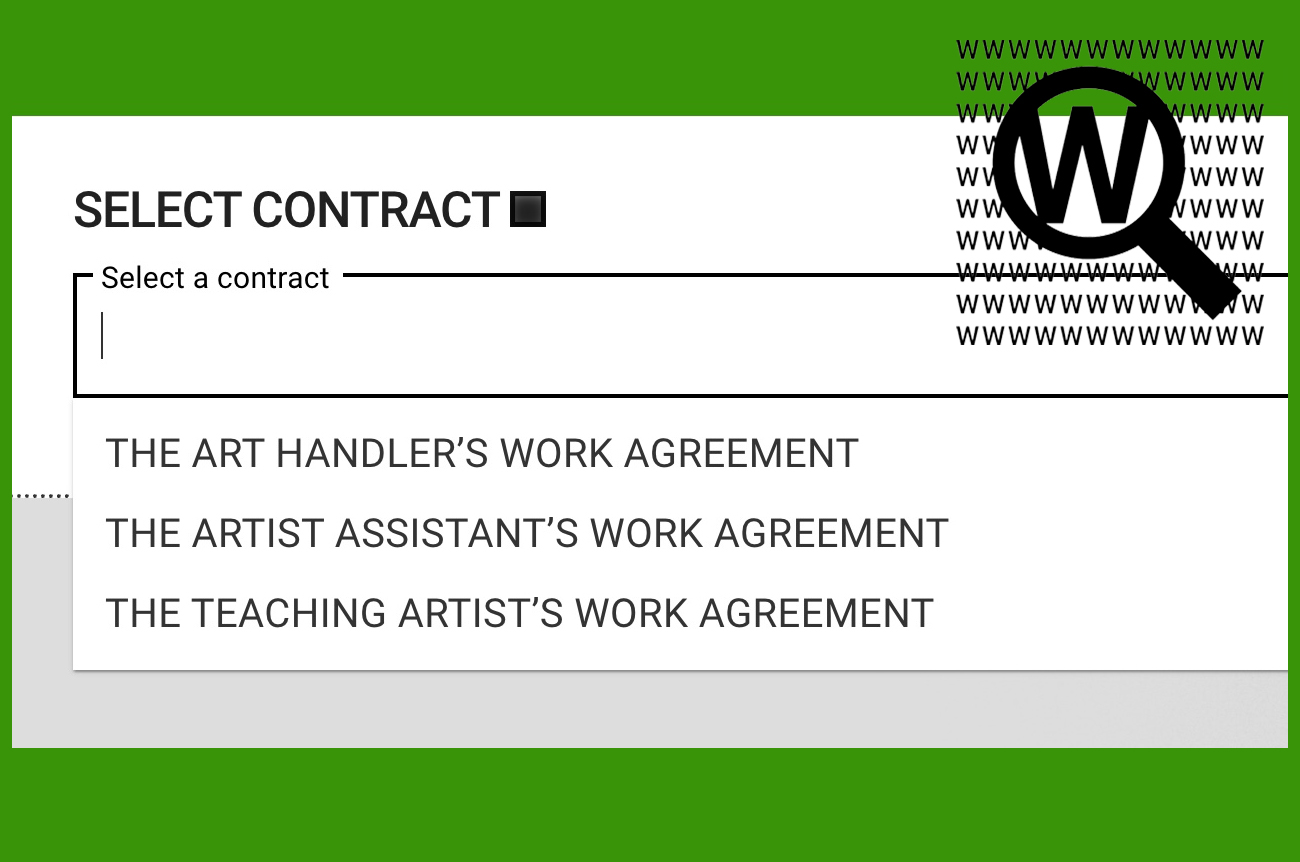
The Contract Generator was conceived to make the use of contracts straightforward, standard, and widespread. It produces PDFs for negotiation and signature from interactive, fillable forms. Developed through worker roundtables and drafted by a contract and employment lawyer, each agreement is a 'bespoke' legal document that addresses the specific economic and legal protections generally not available to independent contractors for each position. Because the agreements clarify and amplify workers’ status as independent contractors, they cannot be used by employers to contract employees.
While instructional and easy to use, the generator does not simply draft agreements. Instead, the drafting process is designed to be an instrument of learning.
Read more about this project here .
How to use it
1.
Enter your business contact information in the account settings.
2.
Select an agreement from the menu.
3.
Select a payment method.
4.
Select your role as either contractor or hiring party.
5.
Draft the agreement by reading the instructional text and filling in all form fields where applicable.
6.
Generate a PDF for negotiation and signature.
7.
To make changes, either draft a new version or use the strike-through method in the PDF.
FAQ
Do I get paid through WAGENCY?
No. No financial transactions take place through the platform.
Can I send fee requests to institutions outside the United States?
If the institution is a nonprofit registered in the U.S. but located elsewhere you can, but otherwise, WAGENCY is limited to institutions based in the U.S.
Can I send fee requests to commercial galleries?
No. WAGENCY is for negotiation between artists and nonprofits.
Can I send fee requests to W.A.G.E. Certified institutions?
Yes. The fees of W.A.G.E. Certified institutions are determined by their projected current annual operating expenses and are pulled from information submitted to W.A.G.E. each fiscal year.
Can I send fee requests that are higher than W.A.G.E. standards?
Yes! And we encourage you to do so.
Can I send fee requests that are lower than W.A.G.E. standards?
No. WAGENTS are required to begin by requesting W.A.G.E. fees.
What happens if the institution declines to pay me W.A.G.E. fees?
You have two choices:
1) Decline to work with the contracting institution.
2) Continue to negotiate until you reach an agreement.
Can anyone else see my correspondence with institutions?
Only W.A.G.E. can see your correspondence and we will only view it if you request help.
Is W.A.G.E. tracking and using my data?
W.A.G.E. is keeping track of transactions in order to understand how WAGENCY is impacting the field and to make those insights available to users. All data is aggregated, fully anonymized. We have made every effort to make WAGENCY GDPR compliant, please read our Privacy Policy and User Agreement .